
25-Year Inaugural Childhood Cancer Report
Making progress in the fight against childhood cancer.
When putting together this report, the South Carolina Childhood Cancer Taskforce united leaders in pediatric cancer, epidemiology and public health throughout the state. Working through more than two decades of data on childhood cancer in South Carolina, they put together a report that gives leaders in health care and families of those facing a cancer diagnosis a more informed look at changes in prognosis and more.
This report was made possible thanks to high-quality cancer surveillance data maintained by the South Carolina Central Cancer Registry under the Department of Public Health. The report is the product of tremendous statewide collaboration between South Carolina’s three pediatric cancer hospitals, the South Carolina Cancer Alliance, the South Carolina Central Cancer Registry and the University of South Carolina’s School of Medicine and Arnold School of Public Health.
Childhood Cancer Report
This report lays a broad foundation for future childhood cancer research, advocacy and intervention in South Carolina. By illustrating 25 years of South Carolina data on the incidence, survival and mortality of childhood cancer, we will be taking an important step together in understanding and improving outcomes for children and adolescents with cancer statewide.
To create the best foundation for the future of care, we must understand the past and present landscape of childhood cancer across the state.
Go to the SC Cancer Alliance Website to view the full report
Childhood cancer survival rates in South Carolina
The information below – a preview of the more complete picture included within the full report – provides a hopeful and inspiring glimpse of how improved access to cancer care and new technologies and research have helped our youngest patients survive and thrive after a cancer diagnosis.
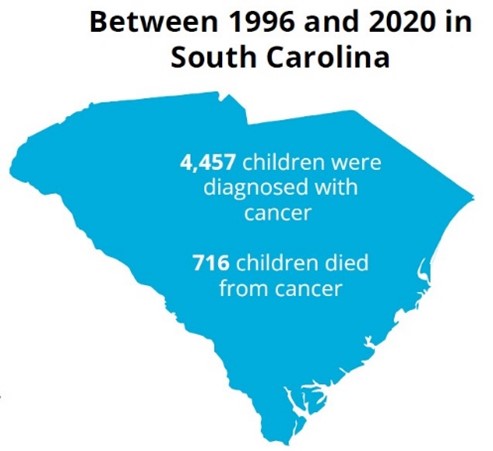
Between 1996 and 2020 in South Carolina
- 4,457 children were diagnosed with cancer
- 716 children died
Percentage change from 1996 to 2016: Childhood cancer survival 11% ↑
Percentage change from 1996 to 2020: Childhood cancer mortality 21% ↓
Statewide progress in childhood cancer survival rates
- 84% relative survival at 5 years from childhood cancer diagnosis.
- This marks an 11% improvement in survival (1996-2016).
- The mortality for childhood cancer has declined 21% (1996-2020).
- Survival improved for 8 of 11 cancer types.
Demographics and future health of childhood cancer survivors
- More and more patients are becoming childhood cancer survivors.
- These survivors come from across South Carolina with 15% diagnosed in rural areas.
- Among those who survived at least 5 years from cancer diagnosis, 2,812 are still alive while 150 patients have died.
- Black patients had a relatively higher risk of death beyond 5 years from cancer diagnosis.
- Most childhood cancer survivors will face a serious health condition by middle age due to cancer treatments in childhood.
Changes in childhood cancer epidemiology
- Between 2001 and 2020, the incidence rate of childhood cancer increased 11% in South Carolina, 13% in the South Atlantic Region, and 8% in the United States.
- The incidence rate of childhood cancer in South Carolina remained lower than the overall regional and national rates.
- We identified rising state incidence trends for childhood lymphoma and leukemia.
Cancer disparities
- Though the gaps have narrowed, relative survival among Black and Hispanic children in South Carolina remained lower than white children with cancer.
- Black children had the lowest survival of all groups.
- White children had the highest incidence of childhood cancer, and the incidence gap between white and Black children has widened over time.
- Childhood cancer incidence was also persistently higher in urban as compared to rural areas.
Race and ethnicity | Incidence rate | 5-year relative survival | Mortality rate |
Non-Hispanic White | 18.1% | 86% | 2.2 |
Non-Hispanic Black | 12.7 | 80% | 2.5 |
Hispanic | 13.4% | 83% | ^ |
Rates per 100,000 individuals at risk (2016-2020), survival estimates for cases diagnosed (2012-2016), ^suppressed due to fewer than 16 cases.